Tuesday, September 17, 2013

Fed Score: Rational Decision (NOT Jobs – 0, Greedy Financial Investors - 1)


I apologize tot he Fed for underestimating their rational decision making.  When I wrote this blog yesterday, all the indication were that the decision to curtail the QE was going to be made.  I am happy that I was proven wrong.

http://www.nytimes.com/2013/09/19/business/economy/fed-in-surprise-move-postpones-retreat-from-stimulus-campaign.html?hp&_r=0 

Many of us in the working world, struggling to make ends meet every day of the year, are oblivious to economic policy formulation and the impact it has on all of us. The system for making policy is very complicated when it used to function but it is no longer functioning.  The system now has been reduced to this:  whoever has the money has the votes and whoever has the votes makes the policy.  Most people don’t want to get involved since they feel that their involvement stops at the voting booth.  All I hear from people, when they talk about fiscal and social policy is:  “THOSE” people in Washington making our lives miserable with their turf battles, or I hear how the House and half the Senate have gone off the deep end.  Maybe they have. Many do not believe that the shenanigans in Congress do not affect them anyway, that what is done is Washington does not matter in their struggle to make ends meet.    As a result we have grown numb to the fights in Washington and many of us have turned off and distance ourselves from the whole process. Bad mistake!

The fiscal, and social policy conflict we see in Washington is akin to the classical struggle between good and evil, the dark side and the side of the enlighten, the oppressed and the oppressor.  The epic story of the Lord of the Rings, successful TV series like Stargate SG1, and epic movies, the latest being Elysium, have this basic struggle as their basic plot.  To some extent the struggle going on in Washington is the real version of all these plots:  You have a group of people that want to be free and have choices struggling against a group of people who want to control them and forced them to their will. The big difference is that in the book, the TV and the movies, the good guys usually win and there is closure to the story – that’s what we pay for.  

 In reality; however, the conflict in Washington is a never ending story where the good guys may lose lots of battles, and in fact, may lose the war.  That is what is happening now, we are losing the war for enlighten life, a life of choice and personal freedom a life of cooperation and selflessness, sharing and philanthropy against the forces of ambition, self gain and control of others.  From what I can tell the forces of enlightenment are losing. 

This week is a pivotal battle is being waged between the forces that will impact the future of jobs in the country.  No, Congress does not vote on cutting the budget again this week.  But that battle will be here soon and the dark side is “digging in” to hold the country hostage once again to try to get what the American people don’t want and indicated in so many ways – the continual destruction of the security net and the livelihood of the average citizen.   To any logical student of history, we are living in a pitiful state of government, with pitiful representation and with pitiful support from the voters. No, this week is not Congress’ turn at the spotlight; it is the Federal Reserve Bank (the Fed).  For several years now they have been unbiased and just about the only source of economic policy sanity in government, but now it looks like they might be jumping over to the dark side.  They are contemplating actions that might result in stopping and maybe reversing meager progress in job growth has made in the country. 

The Fed is on the threshold of changing policy that will impact the availability of jobs in the U.S. They are set to reduce the Quantitative Easing (QE) that the Fed implemented about 5 years ago to stimulate investment in U.S businesses.  The reduction or “taper” as it is being called will cause interest rates to start climbing.  This will increase the cost of investment by U.S. businesses and reduce the creation of jobs.  QE also had the effect of reducing the value of the dollar thereby making U.S. products more sellable in the world market – that advantage will also disappear with the reduction of QE. 

So, what is QE you might ask?  QE is when the Fed (central banks in general) goes from targeting interest rates to targeting the amount of excess reserves held by banks - the quantity of currency in the banking system.  The Fed does this by buying financial assets in exchange for reserves. With QE the target is the level of purchases and not the interest rate.  In our case the interest rate was almost zero so QE can be seen as driving the “virtual” interest rate even lower than zero and giving businesses a bigger incentive to invest and create jobs.  In November 2008, the Fed announced that it would buy the debt of government-sponsored enterprises (GSEs), such as Fannie Mae and Freddie Mac, as well as the mortgage-backed securities (MBS) that these enterprises sponsored. The goals were to lower borrowing costs and to directly ease credit conditions in the housing market. The goal was to further support economic recovery and to anchor inflation expectations at manageable levels maintain price stability and promote the maximum sustainable employment possible.
  
The diver for this policy change is the false argument by the dark side that if current policy is maintain, we will have growth in inflation.  Inflation will reduce the profits and the value of the wealthy. It will also impact the poor and what is left of the middle class and should be kept in check.  But inflation is not the main problem now and it will not be for some time.  It’s pretty clear that that argument being made by the “dark side” is like the kid that cried “wolf” when there was no wolf or when Chicken Little claimed that the “sky is falling.” There is no wolf, the sky is not falling and the inflation monster is nowhere near on the “radar screen.”  The point is if the “inflation monster” begins to show his ugly head we will know of it in plenty of time to stop it.  In his most recent article, Paul Krugman argues that the Fed should not temper with monetary policy “Don’t taper, don’t tighten, until you can see the whites of inflation’s eyes,” and to “Give jobs a chance.”  His write-up can be found at:

http://www.nytimes.com/2013/09/16/opinion/krugman-give-jobs-a-change.html?hp&_r=0

QE's intention was to avoid a situation of deflation and prop up the economy and it did and many of the jobs and from in unemployment from 10% to 7.3% was due to that policy.  But we can expect QE to go “poof” and unemployment begin to climb again.  Oh wait, that’s what the “Dark Side” wants so it can help them take back the Senate in 2014 and elect the president they want in 2016.  While a policy of Quantitative Easing is not the long term answer to the working class problems, it has been able to provide a sustainable boost to the economy.  But it looks like this will be a loss for the working class.

Tuesday, September 10, 2013

An Afternoon at the Michigan Renaissance Festival


I have always thought of myself as being born at the wrong time.  What I mean is that I think I was born about 500 years too late.  I always picture myself as part of the late 14th and early 15th centuries and not a product of the 20th century living the last of my years in the 21st.   

The Renaissance is a period of rebirth of the human mind after the period of the dark ages where the arts, sciences and thinking were controlled by the church and the nobility.  The “dark” refers to the emptiness of the mind and soul.  The Renaissance to me means the breaking of the chains that bounded the mind.  To many people the Renaissance means the evolution of the arts, literature, politics, economics, and all aspects of society.  It is perhaps best known for its artistic developments and the contributions of such polymaths (a person whose expertise spans a significant number of different subject areas) as Leonardo da Vinci and Michelangelo, who inspired the term "Renaissance man”.  Although I like the modern technology, I always seek to live with the technology and furnishings of the 15th century.  Moreover, I always seek the basics and basis for everything. 

Maybe this is why I am so attracted to the Renaissance Festivals that are held all over the country.  I went to my first one in 1975 and I’ve been hooked ever since.  Although there is very little or anything “real” about the recreation of the renaissance period in these fairs, it is the only approximation that we have to “relive” that period.  Costumed actors and vendors filled the fairgrounds dressed as princesses, lords, peasants, vendors, musicians, performers, pickpockets and every walk of life of that time period.  Of course, there are many in costume, not so much from that period but to walk around in “sexy” outfits – yes you know who you are!  They even have the Queen of England, who although carries herself in a very royal manner both and dress and language, but she still carries a mirror to spy under the kilts of her “subjects,”  The whole festival is an adult comedy show with a lot of sexual undertones, and in some cases not so subtle. 

Of course you have your performers performing both on stage and festival streets, and your vendors with “basic toys” carved from wood like swords and carts, and you have the candles, and the jewelry, clothing and other “period” appropriate stuff.  Of course you can’t go to the festival without sampling a turkey legs, fried pickles and other “period” foods that I’m fairly certain were not available in the late 14th century. Although you can go in 21st century clothing, it is an opportunity to wear a period costume while enjoying the festivities; many people get dressed up in character.  Anyone can be anybody from that period they want to be for the weekend.

As for me, I always mosey toward the Guinness Pub about an hour and a half before the end of the day (7:00 p.m.) and party with the performers, including the Queen and her court – What fun!  The beer and wine start flowing and, unfortunately, at the peak of merrymaking, the canon is fired and the fair is over a 7:00 p.m. – bummer!

It is lots of fun.  I recommend it!  Best $17.50 (if you buy the tickets at Kroger) one can spend for a whole afternoon.  Below is a link to a youtube video clips and photographs I took last Sunday.  ENJOY!

Monday, August 26, 2013

San Francisco and the Bay Area- the last of the Vacation


The word China is derived from Ch'in, the first dynasty to unify the country by conquering the warring feudal states and took the title first august emperor in 221.  During short his reign over China, the Ch’in Dynasty also introduced several reforms: currency, weights and measures were standardized, and a better system of writing was established. He also did some terrible things; an attempt to purge all traces of the old dynasties led to the infamous burning of books and burying of scholars incident.  Two of the key things that he did was to standardize the Chinese language by having all writing be the same; south and north china may sound different but they can communicate in the same writing.  The second thing that he did was to standardize the length of the wagons wheel base.  Chinese roads were grooved to different size axels and one wagon could not go into a different region because of the different wheel base.  Simple things like that is what made modern china possible.  (Although my major in college was engineering my minor was in Chinese history.)

But when it comes to standardization, Emperor Ch’in had nothing over the U.S.  We have Fast food everywhere (McDonalds, Burger King, Wendy’s, etc) and we also have standard shopping centers with Kohl's, Target, WalMart,; standard gas stations, standard roads and road signs, standard dress and modes of behavior (except for Mt Shasta, CA where the 1960 Berkley hippies retired) and standard evolution of our language.  One of my frustrations is that no one responds “You’re welcome” to the expression “Thank you.”  Everywhere you go in the country the new standard response to “Thank You,” from everyone one under 40, is “No Problem.”  To me that is not an expression acknowledging the fact that the person saying “thank you” is grateful for your kindness.  It is more of an expression of “Yeah, I know I did something good for somebody, I did not mean to, and it was no problem to me to take some casual effort from my busy life to casually help out a destitute.”  I feel like I’m being left behind in this language evolution, but nonetheless, I will continue to use the response “You’re welcome” when someone says thank you.

OK, back to the travel summary:  we spent our last week as standard tourists in San Francisco and the Bay area, reliving my years at Stanford University and  taking side trips to Monterrey and Carmel, Muir Woods and the beaches south of San Francisco.  It was almost like being home again.  I got to visit my old office in the southwest corner of the Stanford Quad, bought a few T-shirts at the book store and showed Adrian where he might go to school if he got all “A” and aced his college exams – in one ear and out the other.

I took advantage of the San Francisco, Monterey and Sausalito Wharfs to consume my favorite food – Dungeness Crab.  Took the standard tourist trip around Carmel with the 17-mile drive; a chance to see how the other side lives.  I got the feeling that just looking at the players on Pebble Beach golf course was a violation of their wealth domain.  But the scenery was nice, although it would have been nicer if we did not have the constant low-hanging clouds (or high-hanging fog).  Even the Golden Gate Bridge could not be fully seen because of the fog, but we did see, only briefly, one the training runs for the boats competing for the America’s Cup – for a sailor like me, that was a real treat!  Sanford has not changed (maybe a couple of new buildings here and there) but it seemed like time has stood still and I was back in 1975.  Even the cumquat tree outside my window in the office I had as a graduate student and teaching assistant - where I made plans to jump out and climb if I ever felt an earthquake - was still there exactly as it was 35 years ago.  It was good to revisit the Bay area, the weather is perfect, and the people seemed more relaxed.  In a way I wished I had stayed here, but in 1979 I had Washington DC in my eye, and that is where I wanted to work.

San Francisco
 Riding on the Cable Car I felt like breaking out into
a song "Rice-a-Roni the San Francisco Treat."
Although a friend of mine said I should have started singing 
"Y.M.C.A."
 Riding the cable car our life depended on this guy to 
stop us from plowing into the crowd at the 
bottom of the hill.


Eating a dungeness Crab at the Wharf

 In Chinatown a must stop and eat site in SF


I could not tell what these were but they did not look tasty


Street Art

The San Fransisco Skyline in the fog


Monterey and Carmel

 One of the golf holes at Pebble Beach


 Sea Lions on the rocks off Pebble Beach

 Dungeness Crabs on the Monterey Wharf


Stanford and San Gregorio Beach

 My old office at Stanford (in the Basement)
The engineering corner of the Quad where I had my office
 Hoover Tower
 Entrance to Quad and Chapel


 San Gregorio Beach


Friday, August 23, 2013

Mt Shasta and the California Coast


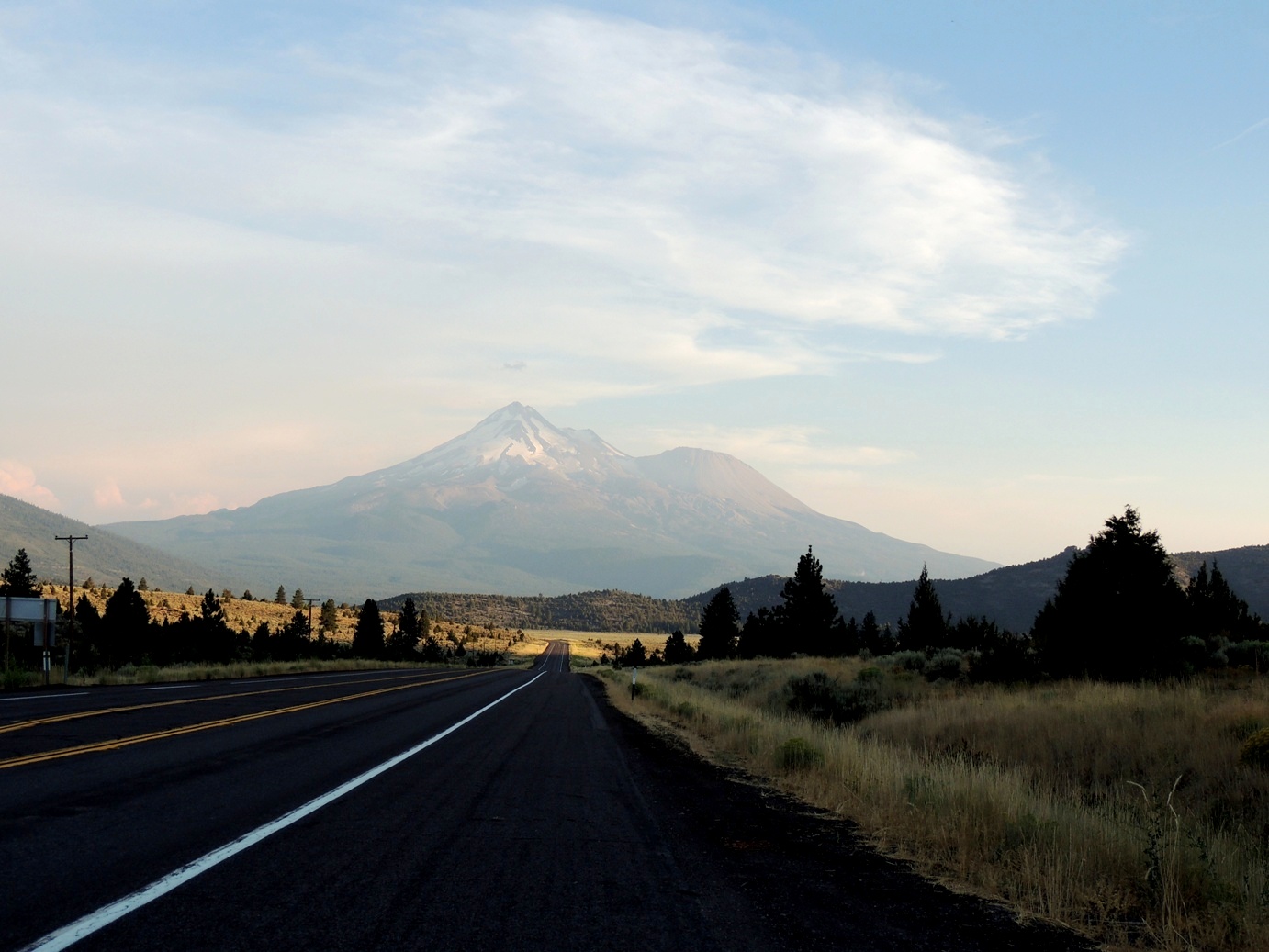
Mt Shasta is so dominating that at 50 miles, crossing the Oregon – California border on US-97, it is the most dominating thing in the horizon.  The dominating peak at 14,179 feet (4,322 meters) is almost as high as Mt Rainier (Mt Rainier is 249 ft higher).  In addition to the main summit the prominent satellite cone of Shastina is 12,330 ft (3,760 m).  It looks so big because it is self standing – it has no other peaks nearby; it rises abruptly above the surrounding terrain.


Mt Shasta from just across the Oregon Border


I wanted to hike the south side on “Sergeants Ridge,” the U-shaped Avalanche Gulch - the largest glacial valley on the volcano.  However, we were behind on our travel schedule and had to be several hundred miles away on Manchester Beach by the evening and still had some tough mountain roads and the coastal road to drive and only had a few hours of hiking time.  We made out way to the trail head at about 7000 feet and hiked the gulch, just above the tree line for a couple of hours and began to make our way back down.  It was a good thing because the air was too thin for serious hiking and we had run out of sun block and probably would have ended up with some serious sunburn had we stayed there all day.

 Avalanche Gulch at about 7800 ft


By the way, if you ever wondered where all the Hippie culture from the 1960s went, wonder no more, they went to the town of Mt Shasta, CA.  right at the bottom of the volcano.  The colors, the dress, the VW buses and bugs painted in wild colors and the smell of weed everywhere - I loved it, it took me back to the 1960s.  Although there were many "older" hippies (my age), I was surprise to see so many young people following the cultural tradition.

The road from Redding  to Eureka on state road 299 had to be the most white-knuckled, butt tightening, muscle tensing, frightening drive I have been in a long time.  160 miles of winding mountain road with only a railing to keep you from dropping 1000 feet to your death (oh wait, there was no railing!)  The speed limit was 55 but all the northern California rednecks – who seem to have trouble reading speed limits, thought it was 70.  The road went from 5000 to 3000 feet in only several miles and then back up to 5000 feet.  Not only was the road and the rednecks with their giant Dodge Ram pickups a challenge, the most scary part were the lumber trucks most of them with tandem trailers full of logs barreling in both directions thinking they had total control of their brakes.  Now, why would lumber trucks travel both east and west?  You would think that lumbering in the west would sell to West side mils and lumbering in the east of the mountains would sell to east side mills.  But Noooooo….  They had to do it the hard way.

From Eureka I took US 101 to Leggett, CA and then caught the CA 1, the coastal road.  I wanted to drive down the coast in the late afternoon and see the sunset on the coast, but because we got a late start from Mt Shasta, we only got to see the end of the sunset as we got to the coast and then the whole coast was quickly covered in fog.  140 miles of narrow coastal road, in the dark with not even a rail to prevent you from driving over the cliff into the Pacific Ocean, was not very much fun.  But it kept me alert and did not even get motion sick.  We finally got to Manchester Beach, our destination for the evening, by 9:50 p.m. and was so tired that we didn’t even had dinner before we went to bed.

The next day we drove the rest of the coastal road to San Francisco and got to enjoy the scenery, although there was still plenty of low fog on the coast.