In the history of the family there are
many things that remain a mystery simply because there is no documentation for
what they did or why they did it. We can
deduce some things about their lives, from reading the civil and church
registrations of births, deaths, and marriages and in some rare cases from
records of property transfers and real estate sales. One can also sometimes find government and
other historical records to learn about such things as political, economic,
social and even weather conditions of that time period and try to make some
sense as to what happened to the families living at that time as to why they
might have done what they did. The objective of this research is to just
simply understand, and not necessarily solve this family historical puzzle. That is what is interesting in genealogical
investigation.
One such mystery is the case of Pedro
Rivera and (Maria) Loreto Gomez, they would have been my great-grandparents on
my father side. They lived in the Hamlet
of San Cristobal within the municipality of Catorce and about 8 miles from the
silver mining town of Real de Catorce, in the State of San Luis Potosí. Pedro was born about 1858 and Maria Loreto
was born in 1861. They grew up in a
small hamlet of less than 200 people and got married in 1881. They had at least six children and it seems
that five of them were born in San Cristobal and in Real de Catorce and at
least one was born in Parras de la Fuente, in the State of Coahuila de
Zaragoza.
The first set of questions, among many,
are: why did Pedro and Maria Loreto move?
Why did they choose Parras de la Fuente? How did Pedro's family end up
in such isolated little hamlet of San Cristóbal in the middle of what seems
nowhere. San Cristóbal a hamlet in the
municipality of Catorce is located in central Mexico, in a semi-arid climate
and at an altitude of about 7000 feet - very marginal conditions for
farming.
It seems that the Rivera Family was well
established in the town of Catorce since Pedro's father (José Hipolito Rivera)
was born there in 1830. That implies
that his grandfather Juan Nepomuceno Rivera was also living there. Moreover, by inference in the baptismal
record, Hipolito's grandfather, Jose Policarpo Rivera and his wife, Maria
Fasibia(?) Lucia (my great-great-great-great grandparents) might have also been
residents of that town. Also, by another
implication of baptism records by comparing Hipolito's record with the baptism
record of Maria Loreto Gomez Banda who was baptized there thirty one years
later, it is possible that the parish of the "Purísima Concepción de
Catorce," had not been built or maybe not completed when Hipolito was
baptized in 1830 because the priest does not mention it on the registration. All other registrations I have read have included
the name of the church. Although I have
not found birth records of Hipolito's father and grandfather, it is possible that
the Rivera Family had been living there since the early 1800s and possibly the
late 1700s, during the time when Jose Policarpo was born (approximately 1787).
It's clear that these conclusions are
based on inferences from two simple records of baptisms and a marriage
registration, but it supports a logical deduction of Pedro's life. My only conclusion is that the original
Rivera family that moved there, maybe Juan Nepomuceno or his father Jose
Policarpo, were attracted to that area
for several reasons: First, it offered
them the opportunity to a possible claim of land, although the land is marginal,
it did support some farming. The
community of Catorce was a way-stop for travelers from Monterrey and Texas in
the north, and San Luis Potosí and
Mexico City to the south, that provided a possibility for some business and
growth. The region was relatively safe from Indian attacks from
tribes in the northwest, and probably most important, there was silver mining
in the mountains about 8 miles to the west in the area that would later be
called Real de Catorce.
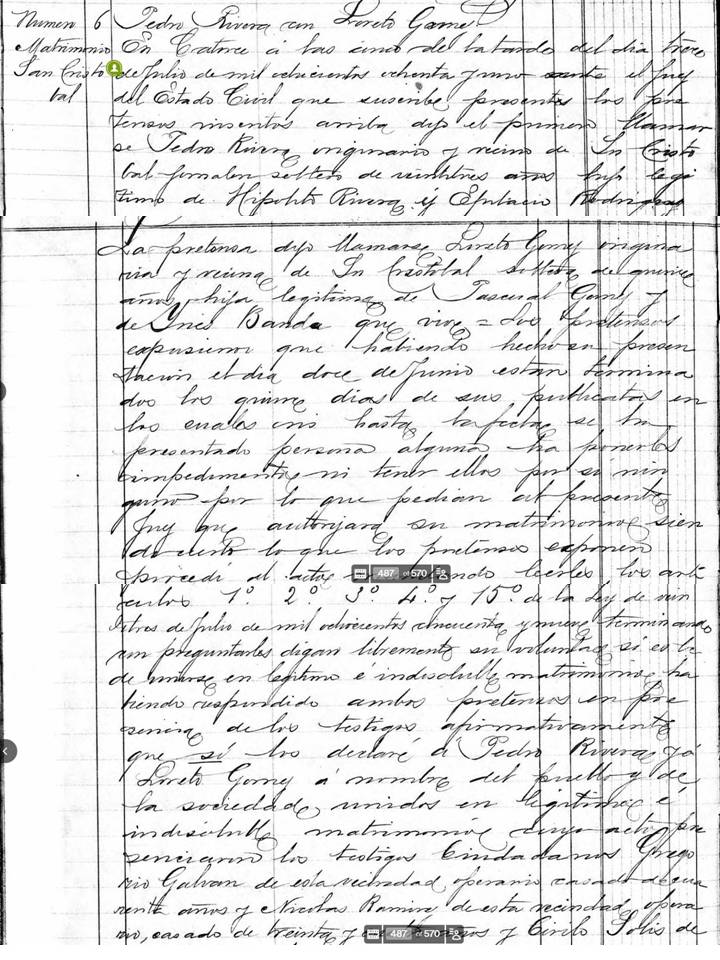
The marriage record of Pedro Rivera and
(María) Loreto Gómez indicates that both were from San Cristóbal. Although in the state of San Luis Potosí
there are two San Cristóbal, one is a locality (or town) within the
municipality of Catorce, which also contains the town of Real de Catorce. The other is a town at a distance of almost
100 kilometers to the south, and about fifty kilometers from the city of San
Luis Potosí. For this discussion, we will
assume that the records are from San Cristóbal near Catorce and Real de
Catorce.
Pedro was 23 years old and Loreto was 15
years old when they married on June 13, 1881.
The age of Maria Loreto is the first of several inconsistencies I found
in the records. The marriage registry
states that Maria Loreto was 15 years old, but her baptism record indicates that
she had to be 21 years old when she married.
It is possible that they, or the Priest who registered them, made a
mistake. What is not possible, is that
in a population of less than a thousand people, there were two women with the
same name and two families whose names are the same; both sets of parents and
grandparents having the same names and surnames.
Thinking about their lives during that
period of time, it is difficult to consider the life of a teenage girl in the
mid-1800s. Seeing it through the eyes of
the 21 century and after 150 years of cultural evolution, living in an
agricultural hamlet with a population of less than 200 inhabitants, hundreds of
kilometers from an urban center, they had no television, or radio. They didn't have video games, there were no
cinemas, opportunities for an education didn't exist, they couldn't travel,
they didn't have access to books or libraries, and their peers and friends were
very limited. A young girl must have had
chores around the house, helping with planting and harvesting, feeding the
chickens and other animals kept close to the house. It is fairly certain girls did not work in
the mines. I think men had a
responsibility to prepare the land, plant and harvest the crops, take care of
the animals, provide general maintenance around the farm, and have the opportunity
to work in the mines.
Pedro Rivera, a young man, almost
isolated from the rest of Mexican society, with the opportunity to work in the
silver mines most probably following the example of his father, Hirohito
Rivera. It is easy to imagine that Pedro
went to work in the mines in Real de Catorce when he was 12 or 14 years
old. He, his father and perhaps his
brothers or uncles who worked in the mines, probably stayed near the mines in
Real de Catorce at night during the week and returned to be with the family in San
Cristobal, about 8 miles away, on Saturdays and then returned back to work in
the mines on Sunday afternoon or Monday morning.
Pedro and Maria Loreto continued to live
in San Cristobal after they got married and about a year later, Anastasio,
their first son, was born in 1882. Although
I have not found the birth records, it seems that Delfina, their daughter, was
born in 1883. She was followed Catarino,
who was born on April 30, 1885 when Pedro was 28 years old and María Loreto was
26 years old (The record says that Maria Loreto was 16 years old when Catarino
was born, but that must have been a mistake because her age does not coincide
with the dates). Two other children were
born between 1886 and 1888. They lived
in San Cristobal until 1888. Something
had to happen at that time that caused them to move to Parras.
At a national level, beginning in the 1870s, the price of
silver began to decline so that by the early 1900s the value of an ounce of
silver had diminished by more than fifty percent. The impact on the silver mines in Real de
Catorce was immediate and they began to close down. Working in Real de Catorce was no longer
viable. Moreover, the low quality farmland
may not have been able to support the growing population and Pedro and Loreto, with their five children
decided to move. Politically, Porfirio
Díaz had become the Dictator of Mexico and although it was bad for the working
people, his policies did allow a lot of foreign investment, including the
development of the railroad that provided the ability to move freight and
people around the country.
Transportation became something that was feasible for ordinary people. Part of the economic boom in Mexico in the
1870 to 1910 that allowed more financing and technology to come in to Mexico,
resulted in the production of textiles in Parras de la Fuente. During the 1860s, the Aguirre family
installed 100 hydraulically run Danford looms for the production of denim
(mezclilla) and other textiles. in 1870
the textile plant was bought and became the "Fabrica La
Estrella." and Parras became a
textile center in Mexico.
Working in the silver mines for 10 to 15 years would have
allowed Pedro to save some money and by taking advantage of the new railroad
they were able to easily migrate to a new location. Maybe Monterrey and San Luis Potosí might
have been too much of a change for a "country family" like Pedro and
Maria Loreto, but Parras would have been about the right size. This, of course, is all speculation, but
somehow the information about opportunities in Parras got to Pedro, most likely
either through a family member or a friend having gone to work there and then coming
back to talk about it. That might have
encouraged Pedro and he might have gone there by himself first, found a job,
worked for a while, and then came back and got the family. I have not found any other Rivera family
contacts in Parras prior to this move around 1888, so this is a possible for
this scenario to explain the move to Parras.
It is clear that they had moved by sometime in early 1889 and were
living in Parras when their son Manuel was born on the 23rd of May 1890.
Below is part of the Rivera Family tree showing the links in
relationships between Catarino Rivera, my grandfather, at the bottom of the
page, born in 1885, to Jose Policarpo Rivera, my
great-great-great-great grandfather, born about 1787, at the top of the page.
For those interested on where most of the
information for this blog came from, I have also included copies of the baptismal
records for Hipolito, Maria Loreto and Manuel Rivera, the Marriage Presentation
of Pedro and Maria Loreto, and the birth registration for Catarino Rivera. Other information on the economy, politics,
geography and weather came from historical records.


.JPG)



.JPG)


