Showing posts with label pyramids. Show all posts

Sunday, April 13, 2014

Cenote Xkeken and Ek’ Balam - Day Five in Margaritaville


We can’t leave Yucatan without swimming in a Cenote.  These were the sacred places of the Maya, the entrance into the underworld and the source for fresh water.  There are no visible rivers in the peninsula of Yucatan because all the rivers are underground.  Over millions of years, these rivers have dissolved the sandstone where the sandstone was weak, resulting in cave-ins, resulting in more dissolving and more cave-ins.  These have left big sinkholes and caverns where the underground rivers form large pools, in other words, natural wells anywhere from 50 to 100 feet below ground.  The Maya build their cities around the Cenotes, the only reliable source of fresh water for drinking and irrigation.
There are hundreds and probably over a thousand large Cenotes in Yucatan and Qintana Roo.  We took advantage of one of the five near Ek’ Balam and went for a quick dip in the Cenote Xkeken; a huge underground cavern with a natural hole in the top that let sunlight in during the mid-day.  The water was about 20 feet deep and the temperature about 85 degrees F.  The Stalactites  and stalagmites must have been growing for thousands of years and the roots from the trees above ground had made their way through the crevices in the rock and down to the water.  It was a very magical site.


 There were some kids painted as Mayan warriers outside the cenote. so we took a picture with them


After our swim, we took a quick drive to the Ek’ Balam archeological site  about 100 miles from Cancun.  The name Ek’ Balam means Black Jaguar in the Mayan language.  Ek’ Balam was the seat of a Mayan kingdom for a long time from about 400 CE to about 900 CE.  The city was an agricultural center for the Maya, they grew corn, honey and beeswax and cotton.


Constant war, overuse of the land, the insane need by the aristocracy to build temples so they could be remembered was the doom of the Maya.  King Ukit Kan Le'k Tok' who build the Acropolis in Ek’ Balam for his own tomb was typical of the construction madness.  That Acropolis alone probably needed the forest within miles around the city cut down.  Making mortar requires lots of heat and since they did not have oil wells, guess where they got their heat?  Wood. With the forest cut down there is erosion, can’t slash and burn to fertilize the soil since there are no trees to burn, they can’t produce corn and food, there are no animals to hunt because the forests are gone and when hurricanes hit, everything was wiped out.  And that is why I think the Maya died out.  Of course, the attack by the Toltec did not help and the coming of the Spaniards with their European diseases just ended up finishing the rest of them.  Of course, there is still Maya these days and the Mayan language survives, but their high culture and civilization had no chance.


the Acropolis on the North side of the site is the largest structure at Ek' Balam and is believed to contain the tomb of Ukit Kan Le'k Tok', an important ruler in Ek’ Balam.  


This is the temple in which Ukit Kan Le'k Tok' is supposedly buried, called El Trono (‘The Throne’). The doorway is in the shape of a monster-like mouth, probably depicting a jaguar.


The Oval Palace contained burial relics and its alignment is assumed to be connected to cosmological ceremonies.


 Other pictures of the site


Saturday, April 12, 2014

From Merida to Uxmal - Fourth Day in Margaritaville


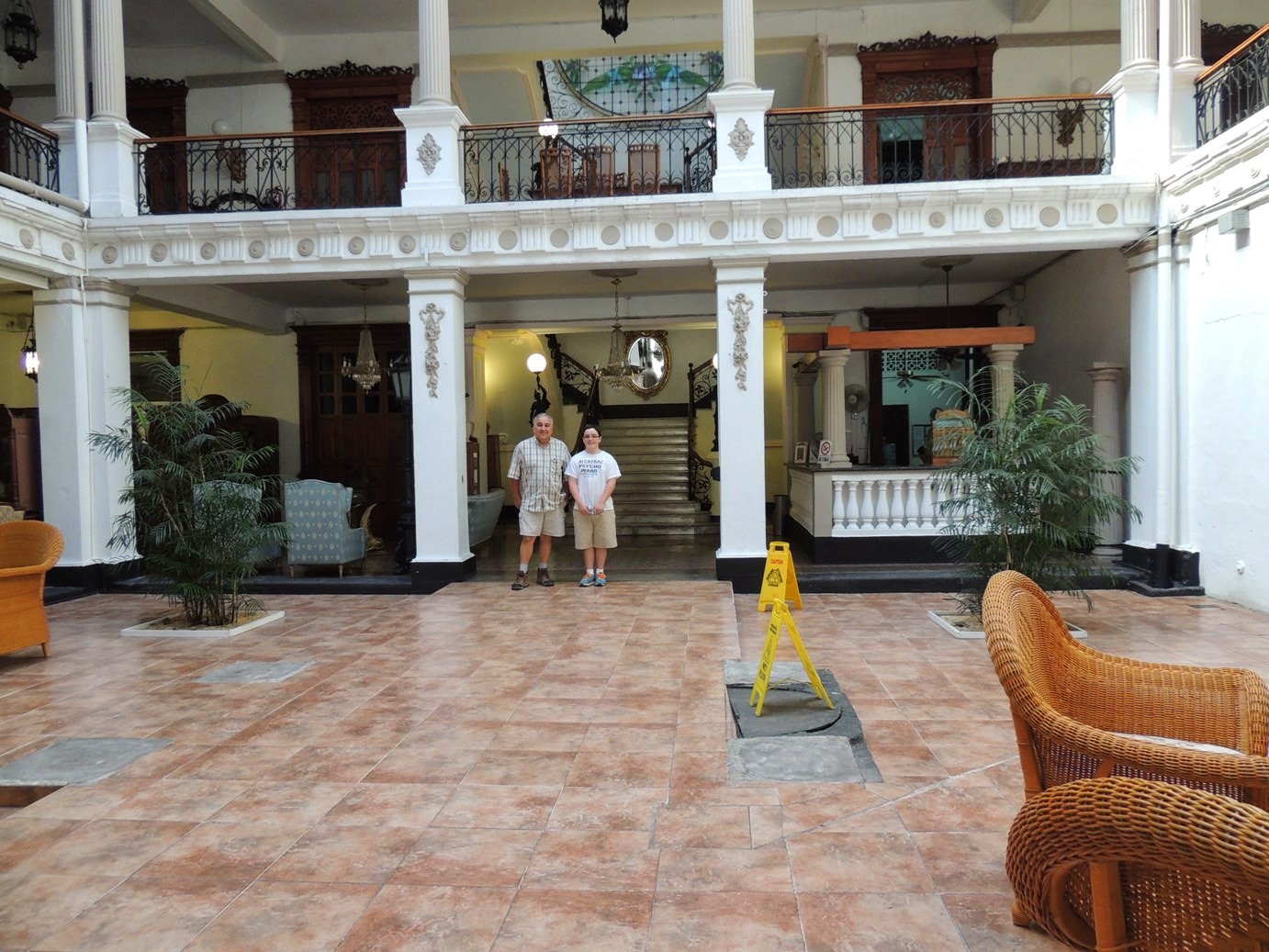
We had a very restful night in the Grand Hotel, although we had a different interpretation of “cold setting” on the air conditioner than the natives there.  Apparently cold to people in Merida means 75 degrees and cold to us means 60, needless to say the air conditioner only went down to about 72.  It was a beautiful morning in downtown Merida.  Everyone was up and working by 7:00 a.m., the shops were opened and the aroma from the bakery down the street made want to go and stuff myself with everything they had.  After a great breakfast we made our way out of the city to Uxmal, our destination.


Uxmal was founded about 500 A.D. by Hun Uitzil Chac Tutul Xiu. For generations Uxmal was ruled over by the Xiu family. It was the most powerful site in western Yucatán, and for a while, in alliance with Chichen Itza, dominated all of the northern Maya area. Most of the city's major construction took place while Uxmal was the capital of a Late Classic Maya state around 850-925 AD. After about 1000 AD, Toltec invaders took over, and most building ceased by 1100 AD.

No new major construction seems to have been made at Uxmal after 1200 AD, possibly related to the fall of Uxmal's ally Chichen Itza and the shift of power in Yucatán to Mayapan.  After the Spanish conquest of Yucatán (in which the Xiu allied with the Spanish), early colonial documents suggest that Uxmal was still an inhabited place of some importance into the 1550s. As the Spanish did not build a town here, Uxmal was soon after largely abandoned.

Unlike Chichen Itza, where you practically get attacked by vendors everywhere, Uxmal was vendor free.  Not only did we have more a quiet time to reflect on the history and the amazing construction, we could also climb and feel the power of the Mayas sitting on a temple on top of the pyramids and other royal and priestly buildings.  Looking back the great number of tourists being taken to Chichen Itza on a “three-hour” tour from Cancun and the hundreds of vendors allowed on the avenues in the site itself makes Chichen Itza a bad experience for someone wanting to “feel and walk among” the history of the Maya and the culture.  If you want to immerse yourself, Uxmal is where to go.

Here is a picture of the complex.  I was breathing a little hard after climbing several hundred steep steps.


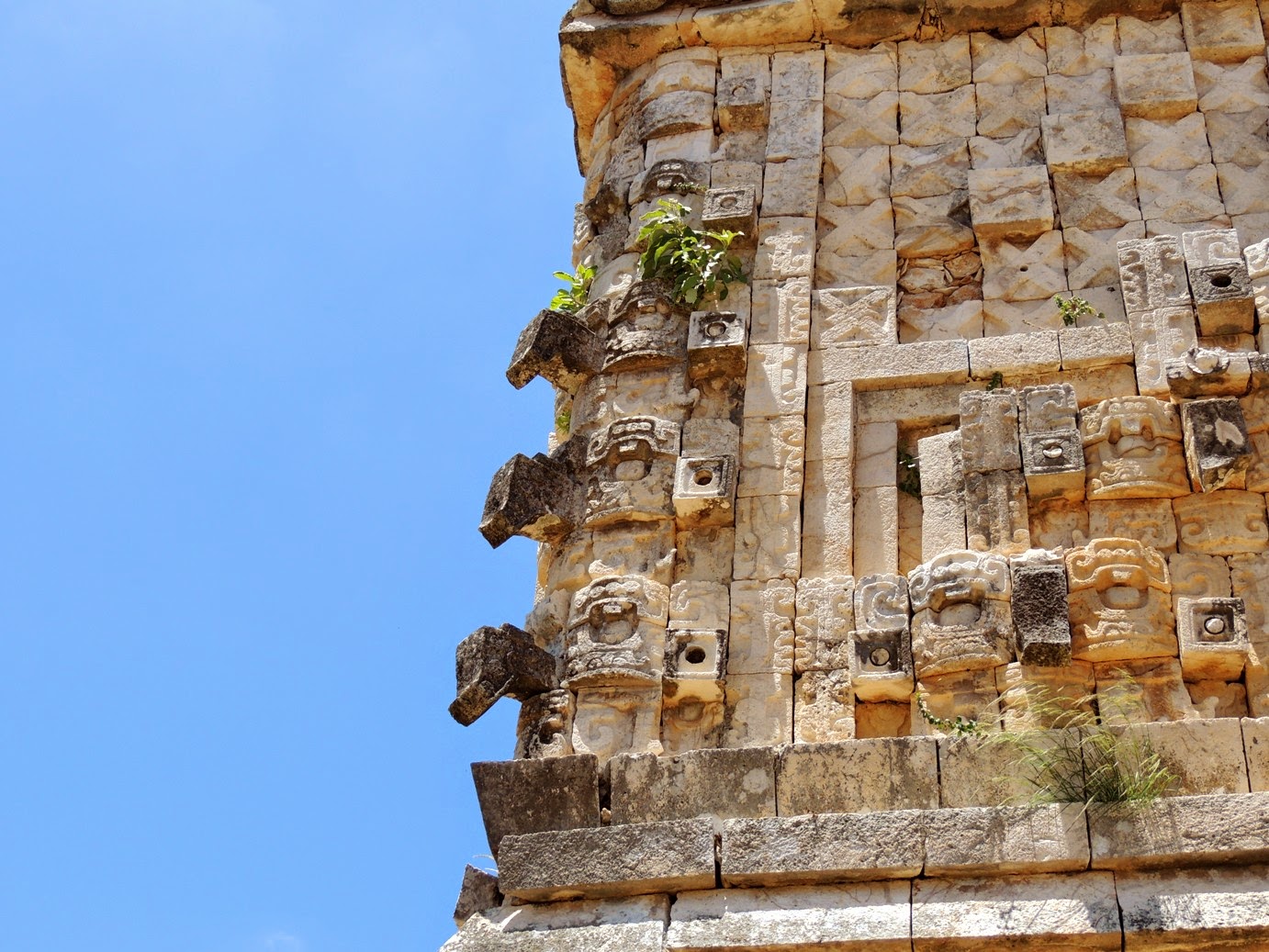
Uxmal is considered one of the most important archaeological sites of Maya culture.  Its buildings  have smooth low walls that open on ornate friezes entwined snakes and, in many cases two-headed snakes are used for masks of the rain god, Chaac.  Its big noses represent the rays of the storms.  The Maya architecture here is considered matched only by that of Palenque, another Mayancity about 500 miles to the south, in elegance and beauty.


The Governor's Palace, a long low building atop a huge platform, with the longest façades in Pre-Columbian Mesoamerica.


The Adivino (a.k.a. the Pyramid of the Magician or the Pyramid of the Dwarf), is a structure, unusual among Maya structures in that its layers' outlines are oval or elliptical in shape, instead of the more common rectilinear plan.


                                                   Entrance on top of pyramid


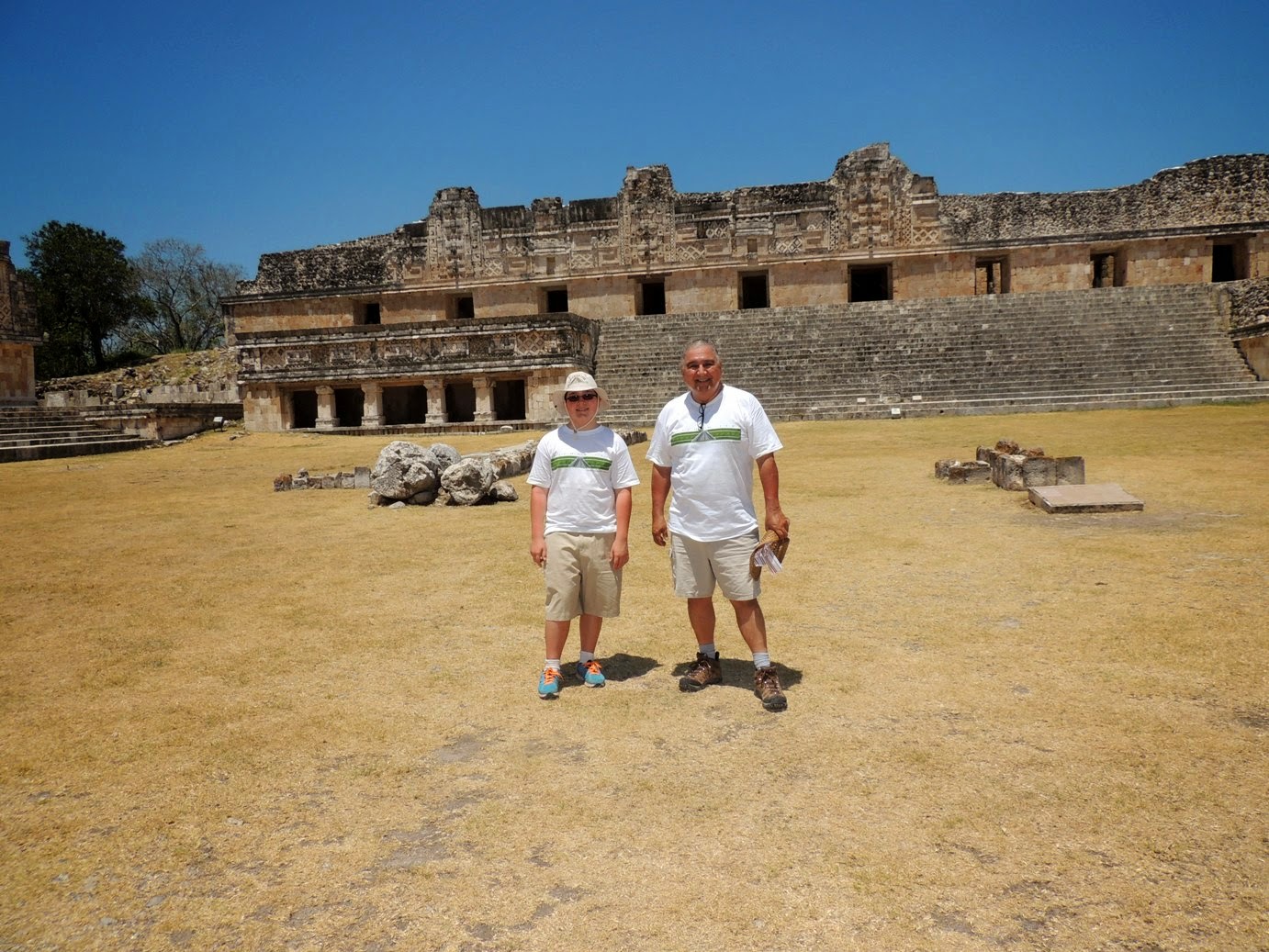
The Nunnery Quadrangle (a nickname given to it by the Spanish; it was a government palace) is the finest of Uxmal's several fine quadrangles of long buildings. It has elaborately carved façades on both the inside and outside faces.


A large Ballcourt for playing the Mesoamerican ballgame. Its inscription says that it was dedicated in 901 by the ruler Chan Chak K'ak'nal Ajaw.  


The Mayan script, also known as Mayan hieroglyphs, is the writing system of the Maya civilization of Mesoamerica, presently the only Mesoamerican writing system that has been substantially deciphered and over 90 percent of the Maya texts can now be read with reasonable accuracy. 


And there are iguanas everywhere.  Here are two fighting.