Saturday, July 9, 2016

24 Hours in Parras de la Fuente


Parras de la Fuente is a small city that time forgot, except for cars and internet, the town is living in the early 1800s.  Don't get me wrong, it is a wonderful place to visit and even live if you want to live with small-town values, be very family oriented, with people who enjoy the simple things in life, like a walk to the town square to speak with friends and family, sit in one of many of the small squares and small parks to have some ice cream (or tacos) and watch the people and the world go by.  All homes (and buildings) are straight out of the Spanish colonial period with original adobe construction and painted in colorful pastel colors; it is candy to the senses.  I hope it will not be overrun by tourists and developers - although I so some evidence of cheap row-housing in the outskirts of town.  There are no Walmarts, there are no large chain stores, there is only local vendors with mostly local producers producing and selling to the locals.  There are mayor industries, and Parras is or was known for denim production, wine production (since the early 1600s - in fact the wine was so good and cheap that the King of Spain prohibited them from selling and competing with Spanish wine in the 1700s and the 1800s).  It produces a large variety of fruits and vegetables because it has been always considered the "Oasis" of the high planes desert.   Parras de la Fuente also contains the roots of the Rivera family line.

 Scenes from Parras - Stores and Business look like regular houses with few signs

My father has always spoken of his family in Parras, but since they not affect me, I never put much attention.  My last trip there, with my father, was over 45 years ago, and the only thing that I remembered was that it was not a place I wanted to be.  I was just initiating my career in the high tech area, and the last thing I needed was to "waste" time with farmers too concerned about, what I considered, were the simple things in life; growing and harvesting grapes , nuts and fruit, making and drinking wine, spending large portions of your life on family time, relaxing and enjoying the trees, the flowers, the food and the people around you.  At that time I thought all that was backward and a waste of time.  I think differently now, and I'm sorry I did not stop and listen, smell the flowers and drank the wine.

I knew that if I wanted to get more facts on the Rivera family, I had to go to Parras.  I dragged my cousin from Monterrey to go with me and made a one day trip there.  All of my father's uncles, cousins and relatives of his generation and the generation of his father were dead, and since I did not bother to keep any records, I had no idea where to start to look for this "lost" family (actually we were the ones that were lost, they had been there all the time).  The town is a little less than a 3 hour drive from Monterrey on the freeway.  We got there about three in the afternoon.  I drove into the middle of town where we knew one of my father's uncles had owned a large variety story, akin to a small K-Mart store.  I parked in the main street of the commerce center, Reforma street, and my cousin and I proceeded to look for the store - nothing!  One old security guard remembered that one of the variety stores used to be a Rivera Variety Store but that was over fifteen years before.   

Disillusioned,  we began to walk back to the car to try to plan our next move.  We passed two little old ladies (and I mean little and old - about 80 years old) sitting on a bench watching the world go by.  We decided to take a change and asked them if they remember a Rivera-owned store on this street.  They did!  In fact, they used to shop there.  But they been closed for a long time and the owner died.  "But," she said, "there are other Rivera store owners around."  My heart jumped and my disillusionment melted.  "I don't know who they are or where their store is, but I can take you to someone who might know."  She said, and proceeded to walk us to a small hardware store about a block away.  The woman at the small hardware store pointed us to a small shoe shop about half a block away.  We went there and it turned out that the lady minding the store was the wife of the owner whose name was Rivera.  The husband was not there and was not due back until later that evening.  Realizing that not all Rivera's are family, we started asking her questions on the relationship of her husband and I could tell that that was going over like a "fart in church."   Not so much that she did not want to tell us, it's just that she did not know.  She did indicate to us where another store was whose owner was a Rivera - about three or four block away. 

The other store was a small grocery stored manned by a man about 50 and had a strong resemblance to my father's father.  His reaction when I introduced myself was interesting, he said I looked like one of his uncles.  After some comparison of family history (as much as I could remember), I realized we hit the jackpot!  He sent us to his 93 year-old mother on the other side of town.  He apologized he could not leave the store unattended, gave us the address and directions to his mother's house and sent us to go and talked to her.  He also gave us the name of a cousin who is a lawyer and had his law office on the way to his mother's house.

 With Second Cousin Maria Olivia and her mother Maria de los Angeles

His mother, although she is 93, took one look at me and immediately said "you look like Juan."  Her daughter, Maria Olivia, in her late fifties, early sixties, proceeded to talk about family history, trying to determined where we fit in the family tree relation to her.  The rest of the afternoon and the morning of the next day went like clockwork, we visited more family members and by noon the next day I had a draft of the family tree with at least ten branches and over one hundred and fifty entries.  I got some addresses, some phone numbers and some e-mails, and even had some Facebook links.  Overall it was a successful 24-hour trip.  I hope to summarize all the information and return in a few months with more time and start gathering family stories.  I got some interesting tid-bits of stories dealing with of family intrigue, stories of adventurers, and businesses, and can't wait to go back.


 With other second cousins

Thursday, July 7, 2016

A Day in the Quest for Family Information


Research into of the Rivera, Gaytan, Garza, the Barrera, family histories, among some of my parents family names, have uncovered some very interesting stories.  Stories of unimaginable tragedies, of sacrifice and endurance under a tremendous odds, abundant wealth and extreme poverty, romantic love and forbidden love, of intrigue and a conspiracy,  and an overwhelming desire by to keep the family together, even at the expense of locking the skeletons in the closet along with the dirty family laundry.  I wish I have had the foresight to document all I saw and heard  when I was younger, and to have interviewed or at least listen to old relatives when they were eager to tell their stories.  Now the bulk of the historical treasure is either lost or hidden in pieces in church and government records and in the minds of older relatives who remember bits and pieces of what they heard or saw.   

I am trying to collect these bits and pieces so they can be documented for our generation, and to be able is like collecting little pieces of a complex puzzle and piecing it together to form a picture of a family in its evolution over the last one hundred and fifty years.  Every conversation with relatives I find or rediscover leads to a clue of who they might have been.  They also lead to the next clue or piece of the puzzle.  Sometimes I feel like a detective trying to piece together a whole novel but only finding one letter at a time, but I have also had some lucky finds that have led me to a whole chapter.

It is difficult to research family history when one lives in Michigan and the relatives and family history are scattered all over northeastern part of Mexico.  Also, for the type of family stories I am interested in documenting, the internet has limited value.  So the only solution is hitting the pavement and knocking on doors.  Luckily, I have a cousins who are also interested in this venture and indulge me enough to help me get around, without their help, I would not be finding these lost relations as fast as I am. 

For example, one of my cousins had a notion of where a "lost" cousin's mother used to live.  So we went to her house.  That aunt, had died many years ago, her house was abandoned, but the door was unlocked and we went in to see if we could find any evidence of where her son might have moved to.  The house was in shambles and we found no information.  A young lady, who took the bus near the house every morning was standing waiting for a bus and we asked her if she knew anything about it.  She indicated that she remembered seeing some man come by a couple of times during the past year but did not know anything else.   An elderly lady a few houses down and across the street was standing in her front porch watching us so we decided to ask her about the woman who used to live there.  "Yes," she said, she used to be my friend until she died a few years ago."  She knew her son and other members of her family.  Unfortunately she did not know where her son lived but she heard she lived near the end of the Metro in the western part of the city.  We found out the name of the street of his last known address from my sister who happened to find a possible address that she had written down over 30 years ago and we set out cruising through the neighborhood for this guy.  Now that we had narrowed the search area to a few blocks, he was easy to find.  It was a great reunion full of hugs, stories, food and drink.  But most important; information I, and the rest of the family did not know, contacts to other family members and clues as to where to find other relatives in a small town one hundred miles away.  So my next stop, this small town, Parras de la Fuente, in the state of Choahuila, (officially the "Free and Sovereign State of Coahuila de Zaragoza") at one time the hometown of the Rivera and Gaytan family.

Below are pictures of my aunt, whose abandon house we visited, the courtyard of the abandoned house and a picture of my lost cousin with his wife.  We were extremely lucky to find him in the outskirts of a city of almost 4 million, without an address and without a phone number. We are now liked up through e-mail and Facebook and phone numbers. 


Guadalupe - circa 1950

The courtyard of the abandoned house


My cousin with his wife and another cousin


All these emerging stories are extremely interesting, funny, sad and tragic, and I hope to bring them to life through a series of books so that our family can have a written version of our history to pass on to other generations.  I have completed and published the first book "Surviving the Avalanche of Life,"  and hove to have the second volume "Living on the Edge of Irrelevance," in the Fall of 2016.  Other priorities kept me from finishing the second book in 2015, but I set a schedule and hope to keep it.

If you are interested in these books, let me know and I'll send you a link.  Also if anyone is interested in providing editorial review for the second and third books, I welcome any help I can get.  You can contact me via Messenger in Facebook or send me an e-mail to my address at rafael@rivera-fam.com.  I'm a little slow in responding, but I will get back to you.

Wednesday, July 6, 2016

Surviving the Heat and Slow Pace of Bureaucracy


Monterrey is the industrial and financial center of the north.  It is a large metropolitan area with nearly 10 million people in the city and surrounding communities.  People are taught to be entrepreneurs from the moment of birth and the work ethic is unmatched anywhere in the world.  The motto seems to be "let's do business."   It is a very efficient city, everybody follow the rules (more-less) and things get done - except when it comes to correcting a birth certificate!  Business in Monterrey runs on rules (both written and unwritten) and there are procedures for everything, the U.S. army could learn a few things from here.

Some years ago, the municipal authorities decided that all city records would be digitized to make the running of city government (and serving the public) the most efficient it could be.  Sure enough, when I went to the new hall of records, a tall beautiful building built near the grounds of an old foundry, I was amazed at the efficiency of the system.  Here I am, a person who was born at home, lived on the farm at the edge of what is now the city boundaries when I was young, lived outside the country for almost sixty years, walk into the building to get a copy of my birth certificate, obtain a certified copy and be out the front door in less than three minutes.  Now that is efficiency!


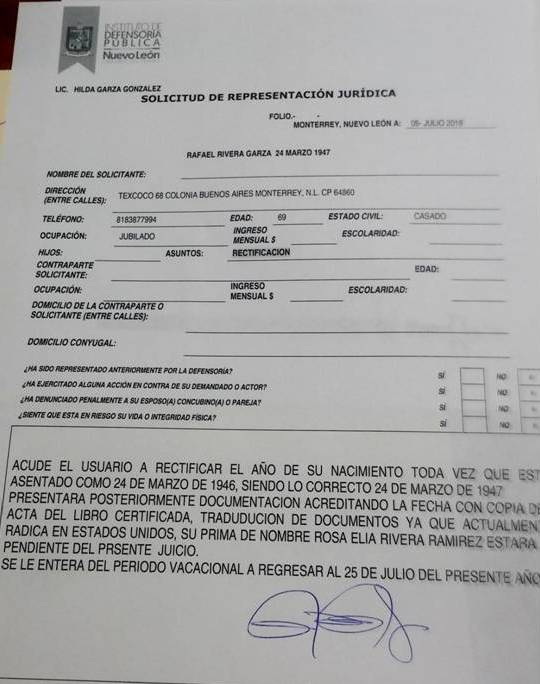
Unfortunately, the certificate had me being born in 1946 instead of 1947.  I went back in there indicating the mistake.  "No mistake Señor,"  and they proceeded to show me printout of digital copies of the original records of 1947.  Sure enough, there was the problem.  It seems that whoever was the clerk at the records office on March 26, 1947 - two days after I was born, took the statement of my birth from my father and very neatly wrote it down in flowery terms probably to impress himself and impress everybody around him.  Instead of writing born on March 24 of the current year he wrote (roughly translated) "born on March 24 of next year's past year."  Why he would write the year that way?  My only guess is that he might have been charging for the number of words he used.  Nonetheless, sixty some years later when records were being digitized, some poor data entry person of the contractor that was probably hired to read and digitize these records, probably a local college student, probably didn't know what to think.  I can just picture the discussion on what the hell this meant.  Some supervisor, probably decided that it was not worth the delay in data entry and told the college kid to just put the "previous year" or 1946.

Where does that leave me sixty nine years later?  "Well Señor, in order to correct this you will have to go to the Office of Corrections and have them petition to change the official date."  The clerk told me.  "But it is clearly a mistake," I told him, "can't you just make that change here?"  "No Señor, this is an official record and changes have to be petitioned to the court and the judge has the final say."

Off to the Office of Corrections that was in a building in the center of the city near the courthouse.  The "Triage" center is a large hall with 13 cubical offices where the clerks determined if you case had the right supporting information and merited further review.  I chose a number "203" and they were attending number 158.  Hey with 13 clerks, how long of a wait could it be, its only 45 numbers.  Well….. I have concluded that all bureaucrats in the world come from the same mold.  They all have three simple objectives:  1- Avoid making decisions;  2- Protect your ass;  and 3- Annoy the living shit out of the client.  The clerk I got was a beautiful young lady and was obviously a bureaucrat in training because not only did she do 1 and 2 extremely well, she excel at number 3.  "Well you seem to have the proper information and your request seems to be valid," she said, so I will send your case to the lawyers upstairs and they will do the formal interview in preparation for your case."  So off I go to another waiting area.  Half an hour later a person comes in to escort me to the fourth floor to where the lawyers reside.  The reason I need an escort is that the elevators on this side of the building are being repaired and we have to go to the other side of the building to use those elevators.  My guess for having an "escort" is that they don't want angry frustrated clients walking around the building by themselves - I guess it's a way to avoid another Texas Chain Saw Massacre.

In order to get to the other elevators we have to go outside the building.  If you want to shock your body, go from a climate controlled 78 degree office to a humid 104 degree sidewalk.  It was only a short walk but just long enough to start me sweating - "just another part of this bureaucratic torture chamber,"  I said to myself, "they are trying to get me to give up my case."  We arrive at the waiting area in the 4th floor and 40 minutes later I was escorted to very good looking lawyer sitting very business-like behind her desk.  "I'm sorry to tell you that I cannot present your  petition to the Court because I am certain that the judge will not accept it."  She started the conversation on a negative note.  "What is the problem,"  I said.  "First, the copy of the official 1947 record of your registration has to be certified.  You have to go back to the Hall of Records and obtain a certified copy."  She said.  "Second, " she continued,  "the judge does not read English, so your passport, your driver's license and any other document in English will have to be officially translated, and the only official translating source is the department of Philosophy and Letters at the State University (the Universidad Autonoma de Nuevo Leon)."  "Would they accept a translation from the Mexican consulate in Detroit?"  I said.  They would, she indicated, but I would have to pay the translation handling fee.

"Well," I said, "I am here this week and I can have them translated and bring them in next week when I get back from Mexico City."  "I'm sorry," she said but his whole office and the court close down this Thursday for vacation and will reopen on July 25th.  So even if you could bring them in this week, your case will not be submitted to the court until after the 25th.  After then it could take up to five weeks to hear your case."  She continued.

Well, I thought to myself, there goes one of my objectives of this trip - to get my birth certificate corrected.   Bureaucracy trumps efficiency everywhere!  At least the family information gathering is going well.


Monday, July 4, 2016

On the Road to Monterrey


 The trip from Tennessee to Monterrey can be long and boring, unless…. You have books on CD.  They are great, makes time go by fast and they keep you entertained through the long lonely road, through traffic jams, stormy weather and even make you forget you have to stop to eat and get gas.  I listen to two murder mysteries and plan to listen to several more on the way back.

First stops:  Texas

I don't particularly like Texas.  The summer weather is bad, it is dry and dusty, I don't care for the politics and how the wealthy are walking all over the lower income people more so than any other State I drove through.  The sad part is that this status quo is accepted by everybody.  But I have some family and friends that live here, so I tolerate coming.

My first stop was to visit a cousin I had not seen in over 40 years.  She lives in Dallas, has had a hard life as a single parent but is surviving - barely.  She tried to find her fortune in the U.S. and it has been an uphill struggle and has had some bad breaks.  But she is strong, optimistic and a hard-core entrepreneur like her father - my uncle.  We practically began our conversation where we left off almost forty five years ago and didn't miss a beat.


My second stop was in San Antonio to see a friend of over thirty years.  We had a chance to catch up on each other's lives and had some great food at the lowest price possible.  Being retired he showed me the best places to eat great food in San Antonio at the lowest possible price. 

On the way to breakfast one morning, my friend happened to drive by The Alamo in San Antonio and I jumped out of the car to take a picture.  I don't consider The Alamo a mythical place of "freedom" that many people in the U.S. have fictionalize as the last stand of 200+ brave men defending their country.  I guess there are two sides to every story, but he fictional whoppers of this one are simply unbelievable.


One side is that about 260 people died defending "freedom."   In modern terms, however, it can also be seen as 260 terrorist died fighting the law in a captured site while the law was trying to keep them from doing more damage.

The facts are that on August 18, 1824, the Mexican government (and Texas was part of Mexico) passed the General Colonization Law. This statute allowed foreigners (U.S. settlers) to gain title to land that was not within 20 leagues of the border of another country or within 10 leagues of the coast. Settlers would be exempt from taxes for four years.  One of the provisions was a stipulation that there be no slavery.  The settlers did not follow the law and tried to force their will through armed force and conflict.  The Mexican army came to stop them, and they did.  Those are the facts.

There has been a lot of glorification and mystification of the Alamo event in order to justify U.S. history.  I guess whoever has the "gold makes the rules," and since the U.S. wanted to annexed Texas, it used that opportunity to apply its large power to take it, along with much of the other land that was once part of Mexico.

I'm not advocating giving Texas back, reality is what it is.  But I'm not about to swallow all this fictional bull that glorifies an illegal action by a bunch of people that we would now consider terrorist in any sense of the word.   And no, The Honorable David Crockett of Tennessee did not die a la John Wayne like in the movie. He was captured and executed immediately after the battle of the Alamo on March 6,1836.

I very briefly crossed the border into Mexico to visit my Uncle and my Aunt in Nuevo Laredo.  He is the youngest of the Rivera Gaytan family and with my dad (who will be 91) the only surviving family of that generation.  I had wanted to interview him for the books I am writing, historical novels on the Rivera Gaytan family and he did don’t disappoint me.  We had a long interview about his life in the early years and I plan to stop on the way back to continue the interview.  For those interested the first book in the series, "Surviving the Avalanche of Life"  can be obtained through The Book Patch,  http://www.thebookpatch.com/BookStore/surviving-the-avalanche-of-life/517d6856-2341-46f9-858d-2e9d8f5e22c8?isbn=9781633183155


I got back on the U.S. side (it took almost an hour with all the security stuff we had to go through) and proceeded to Mission and McAllen, Texas.  I managed a brief visit with one of my dad's cousins (my age) whom I am using as a "sounding board" for the historical novels I am writing.  She has a good "Gaytan" perspective of the history and I have the "Rivera" perspective.

The road to McAllen, hugging the the border, was interesting by the huge number of police on the road and by the beautiful lanscape covered by mestique and cactus.  I had to stop and take pictures (avoiding the rattle snakes and surviving the searing heat). I wanted to pick some of those cactus pears and eat them like I used to when I was a kid, but I had no way to pick them without getting a million thorns in my hand.


I left my car in another cousin's house and took the bus to Monterrey  - I didn't want to deal with all the paperwork and insurance costs since I'm going to be travelling by plane in Mexico.

Into Mexico!

One of my cousins picked me up from the bus station and after some beers, some delicious tacos, and great conversation, there was nothing better than a comfortable night sleep in a cool house.  Justin case I did not mention it, it has been over 100 degrees F ever since San Antonio, and Monterrey is not known for its cool weather in the months of July and August. 

My first day in Monterrey was to visit my aunt - one of my mother's younger sisters and the only one left of her generation.  She is 83, still in great physical shape and her mind is as sharp and anyone I know.  Five hours of very pleasant, fun, and very informative conversation went by as if they were minutes.  She filled in some family historical information that I did not know.  All in all, it has started out as a very profitable trip for information gathering.